Showing posts with label Twitter. Show all posts

Monday, July 11, 2011

How Four Months Can Very Soon Feel Like Four Years

Strange just how much can happen in one-third of a year.

Four months ago to the day, I was wheeled into an operating theater in Denmark's top hospital. In the intense few hours that followed, a gifted surgeon and a deeply professional team obtained a dream result: they successfully resected a malignant tumor from my pancreas and then took an incredible number of biopsies from surrounding tissue, just to be on the safe side. Each and every one subsequently came up negative, so the cancer hadn't spread.

I wrote briefly about the experience of being both diagnosed with the deadliest of all the cancers and spared/saved from it all within the space of three weeks. Many people have asked me: how have things been going since?

The answer is not simple, for one reason: chemotherapy.

As part of its world-beating approach to combating deadly cancers, Denmark's University Hospital recommends and requires that a "cured" patient nonetheless undergo follow-up chemotherapy...for six months.

Three of those months - nearly - have now elapsed, though I have to admit that no month when you are undergoing chemo "elapses" (if only). Having one's post-operative existence divided up into 21-day cycles, each one marked by rising levels of heavy metals in one's body, well it's no walk in the park, alas. And the side-effects of the chemicals used [PDF] - I can testify - are in some ways as insidious as the original cancer, in that they are gradual, but comprehensive.

In my case, and remember each and every cancer patient reacts difficulty, I managed the first three cycles, 63 days, with only a few setbacks. But the fourth cycle somehow knocked me sideways, which is why you have heard so very little from @jg21 on Twitter, and seen so very little of me on Facebook since June's wonderful 8th Cloud Expo in NYC.

The past three weeks, in fact, have brought me face-to-face with some very harsh realities. The final three months of chemo are going to be a challenge...and, in order to successfully meet that challenge, I am going to have to dramatically rearrange my professional priorities so as to maximize healing time, minimize stress, and optimize my working day.

For all indirectly affected by this epiphany, which would probably have been better had it come a tad sooner, I apologize. But never has "less is more" been truer. For me to be back to fighting fitness - and weight! - for the Fall, I need finally to accept that convalescence (from Latin convalescere, whose root is in valescere, to be strong...which I currently am not) isn't something that you just "fit in" around all your other commitments; it is something you have to prioritize ahead of those commitments.

My aim in July, August and September then is to write, but to do so largely offline. You will still see the results online, but only as and when they are uploaded. Look out soon, for example, for my updated and hugely expanded Top 350 Players in the Cloud Computing Ecosystem, for an entirely new feature, Around the Cloud in Eighty URLs, and assorted other features aimed at providing convenient one-stop destinations for Cloud insights and information.

I need a 3-month respite from Twitter. By the final three months of 2011 I shall be completely done with chemotherapy, will no longer be tasting heavy metal at the back of my throat 24x7, will no longer be falling asleep for 12 hours at a time, and will no longer see every muscle group in my entire body subject to the ravages that only chemo can exact...a fierceness that has no respect for former waist or neck sizes.

I repeat to myself twenty times a day that it is better than the alternative. And it is. But it would be wrong of me to pretend that this hasn't been the longest four months of my life, and that I am steeling myself for a rough final three months still ahead.

When all is said and done, it seems a ridiculously small price to pay for surviving pancreatic cancer. I am very very grateful.

It brings to mind the words of the writer Melodie Beattie, who memorably noted:
Gratitude unlocks the fullness of life. It turns what we have into enough, and more. It turns denial into acceptance, chaos into order, confusion into clarity.... It turns problems into gifts, failures into success, [and] the unexpected into perfect timing."

Sunday, May 1, 2011

It Is Time To Help the Web Be All It Can


May 1st seemed the perfect day to just take a few moments to pause and take stock. This is going to be the only year of my life (I hope!!) involving an escape from death, and in those circumstances it is difficult to prevent oneself from wondering how best to use the gift that has been handed to me: nothing less than the remainder of my life.

So let me report on the results...

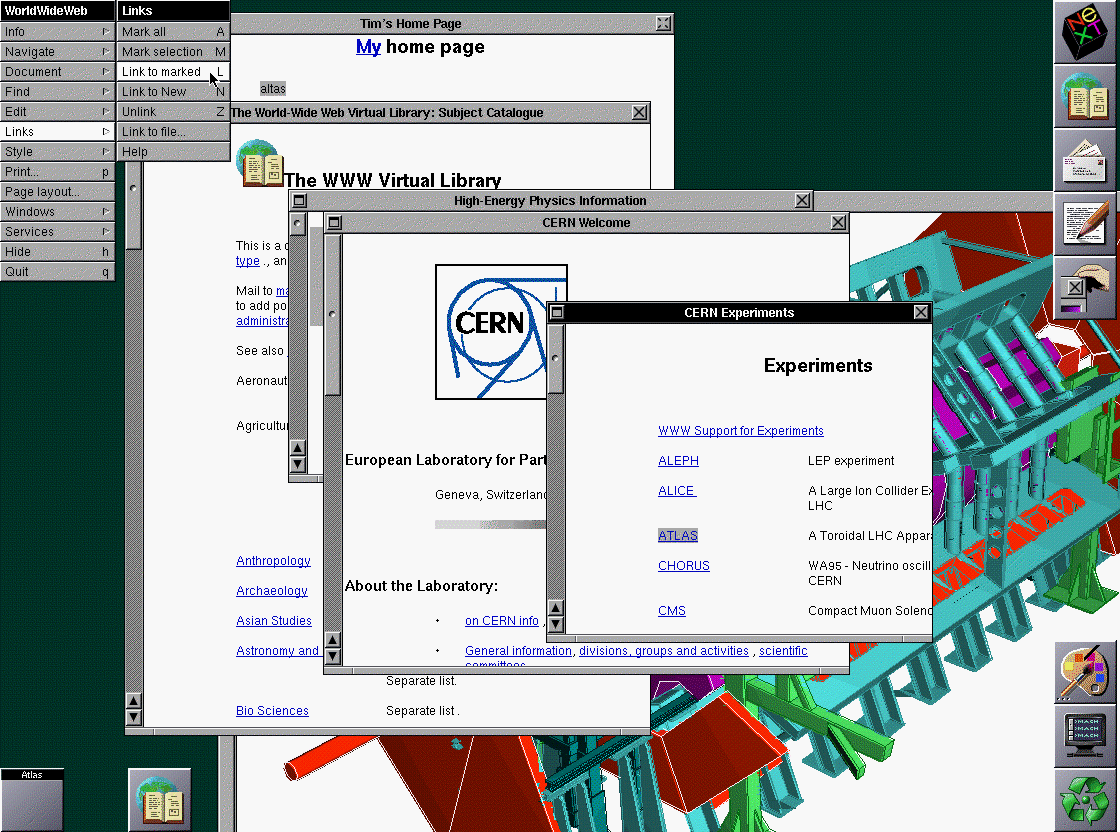
First, a brief historical preamble. Eighteen years ago - on April 30, 1993 - CERN released the source code of the world's first Web browser and editor into the public domain. It was called WorldWideWeb, all joined together just like that, and Sir Tim Berners-Lee has some screen shots of it at his CERN page.

It would be very difficult to argue anything other than that, in the eighteen subsequent years, the technological trajectory that CERN's browser heralded has resulted in tumultuous changes in business, education, government, entertainment, and society. Did it cause them? Maybe not. Did it accelerate them? Hell, yes!!

"CERN's intention in this is to further compatibility, common practices and standards in networking and computer supported collaboration," wrote CERN in its accompanying note to the release of the code (pictured above). It was a phrase that resonated with me then, and it is one that resonates with me still today. "Computer supported collaboration" - on which I published a pioneering book in 1994 edited by the late Peter Lloyd - is, in my view, the philosopher's stone of the World Wide Web. Like that imaginary substance that people in the past believed could change any other metal into gold, "eCollaboration" has been touted throughout every one of those eighteen years as the real payoff from the Web....if only companies, organizations, governments and indeed society at large could figure out how to harness it.

Email is the world's most widespread form of computer supported collaboration. Facebook is another, far more recent one - as is YouTube and eBay and Skype and of course Twitter. Yet it is my view, and has been for many years, that none of these technologies or applications or sites unleashes the true potential of co-intelligence - the shared or group intelligence that emerges from the collaboration (and competition) of many individuals.

So how can we get from TBL's browser to a truly co-intelligent world?

That, as I reflected on May Day in my book-lined, technology-rich work studio, is the crucial and most significant question of our time. It is also a question to the exploration and answering of which I am intending to devote a significant proportion of my efforts, moving forward.

"There is a quantitative element to human affairs," as H.G. Wells once famously wrote. "Doing something does not amount to very much if we do not do enough." [my emphasis]

Saturday, April 2, 2011

Are We Tweeting Ourselves To Poverty?

So James Franco has declared that 'Social Media Is Over' and done the unthinkable...he has shut down his Twitter account.

Will the world stop spinning? Is this the end of western civilization? What next, will people stop asking questions on Quora, will they cease to publish photos on Facebook, will we see the end of Skype-messaging? Worst of all, might the long-awaited Godot known as "Enterprise 2.0" now never turn up?

Well I have news for us all: Franco may be righter than he knows.

It is not that Social Media Is Dead, however. It is that "Social Media" itself is too fanciful a term, right up there with "Social Shopping."

Personally I am not convinced that Twitter is primarily a social medium, I see it more as a collaboration tool that has been momentarily sidelined and become stereotyped in its usage despite its infinite applicability.

But then that is the curse of "Social" - the word has a track record of bogging down all that it engulfs.

One example. I am so ancient that when I first studied "Social" and Political Science at Cambridge, there wasn't even a Social Science faculty, my degree course was affiliated to the Committee of Social & Political Science. Adding the word "Social" to science, back in the day, was akin to adding the word "Fair" to trade. People smelled a rat!

Now it gets added to anything and everything, so that we have the Social Graph, we have Social Data, and we even have Social Authority. But the mother and father of all the "Social" colloquies remains "Social Media."

Let's see whether James Franco's move this week triggers a debate as to whether we are not about to see a correction in the international marketplace of ideas, a retrenchment from the strangely misguided notion that the hand the writes the most Tweets rules the world.

No wonder China is out-pacing the U.S. on so many metrics of productivity and economic progress: according to Nielsen, social networking now accounts for 22% of all time spent online in the U.S.

Wednesday, September 29, 2010

Why Blogging is Not a True Co-Technology

Speaking today in Tokyo at The New Context Conference 2010, the founder of Twitter, Biz Stone (pictured), put onto the record two sentences that will stand the test of time in the era of social computing:
"Twitter isn't a triumph of technology it's a triumph of humanity. A more connected world leads to a more empathic world."

Interestingly, Stone makes this observation in the self-same week that saw the sale of TechCrunch, Inc. to New York-based AOL - triggering a spate of commentaries along the lines of This Is the Death of Independent Blogging.

Is this an inflexion point? Hell, yes. And a big one. This week is also the week in which, as Guy Kawasaki reminds us, that Twitter's traffic overtook that of MySpace.

So what is going on? Why is independent blogging being characterized as dying at the very moment that tweeting is becoming as natural a part of the interconnected world as breathing?

The key, I believe, is in that word "ïnterconnected" - because blogging, for all its merits, has always suffered from that one huge shortcoming, namely that (notwithstanding the excellent innovations like RSS, Trackbacks, the Technorati real-time APIs and even Google's Blog Search) it truly isn't very interactive. I blog, you blog, he/she/it blogs. We hyperlink to each other, but that is about it. Blog feedback threads are frustratingly isolated silos. In fact, to be blunt, blogging is about as innovative a use of the Web as propping open your office door with a Xitami web server.

Tweeting, in contrast, is quite another pair of shoes. Twitter is a true co-technology. And only co-technologies will truly flourish, in the second decade of the 21st century.

Biz Stone is right: "A more connected world leads to a more empathic world." That is after all one of the pillars of co-intelligence, of the belief that none of us is as smart as all of us.

It is going to be the most interesting decade ever. You heard it here first!

Disclosure: I have never been a huge proponent of blogging, as made transparent by this 2007 article.